Key takeaways
- 1On multiplier calculators, TDEE ≈ estimated maintenance calories — the hold-weight line.
- 2Is TDEE my maintenance calories? For planning, yes: use that number as maintenance until the scale disagrees.
- 3Eating at TDEE is for holding weight. Losing fat means a modest deficit from a verified line (often ~300–500 kcal/day for many adults).
- 4Numbers diverge for BMR-only screens, Method 2 baselines, watch burns, and lab tests — not because “calories stopped counting.”
- 5Recalculate after meaningful weight or schedule changes; check with weekly averages for about 14 days.
You finish a TDEE calculator, write down a number, then open a diet app that talks about maintenance calories. Same idea — or a second mystery target? That confusion is why people search tdee vs maintenance calories and the blunt twin: is tdee maintenance calories?
On the kind of free tools most people use (BMR × an activity multiplier), the honest short answer is: they are the same practical line. Your TDEE estimate is the intake that should roughly hold weight if the inputs were honest. Fat loss is not “eat your TDEE.” Fat loss is eat below a verified TDEE/maintenance estimate. Muscle gain is the mirror image: a small surplus above that line.
This guide locks the definitions, shows when the words quietly diverge, and walks one lb/kg example so you can stop collecting duplicate sticky notes. When you are ready, run the free TDEE calculator and treat the result as estimated maintenance — then decide hold, cut, or surplus on purpose.
Short answer: same idea on calculator math
TDEE vs maintenance calories is usually a vocabulary problem, not a second formula.
- TDEE (total daily energy expenditure) describes output — how many kcal your body tends to burn in a day when you include resting metabolism, daily movement, digestion, and training.
- Maintenance calories describe input — how many kcal you need to eat to keep weight stable over time.
When the estimate is close to reality, those two numbers meet. That is the tdee maintenance calories meaning you actually need: one line for “hold,” then a planned offset for cut or surplus. You do not need two unrelated targets from two apps.
After you understand the fork, recalculate your TDEE once with honest height, weight, and activity — then write “maintenance” next to that number so the next app screen cannot invent a second line.
What each phrase means in plain English
TDEEHQ breaks the day under how your body spends calories:
- BMR — resting cost
- NEAT — steps, fidgeting, job movement
- TEF — digestion
- EAT — formal exercise
Most free calculators skip the long shopping list and use:
Estimated TDEE ≈ BMR × activity multiplier
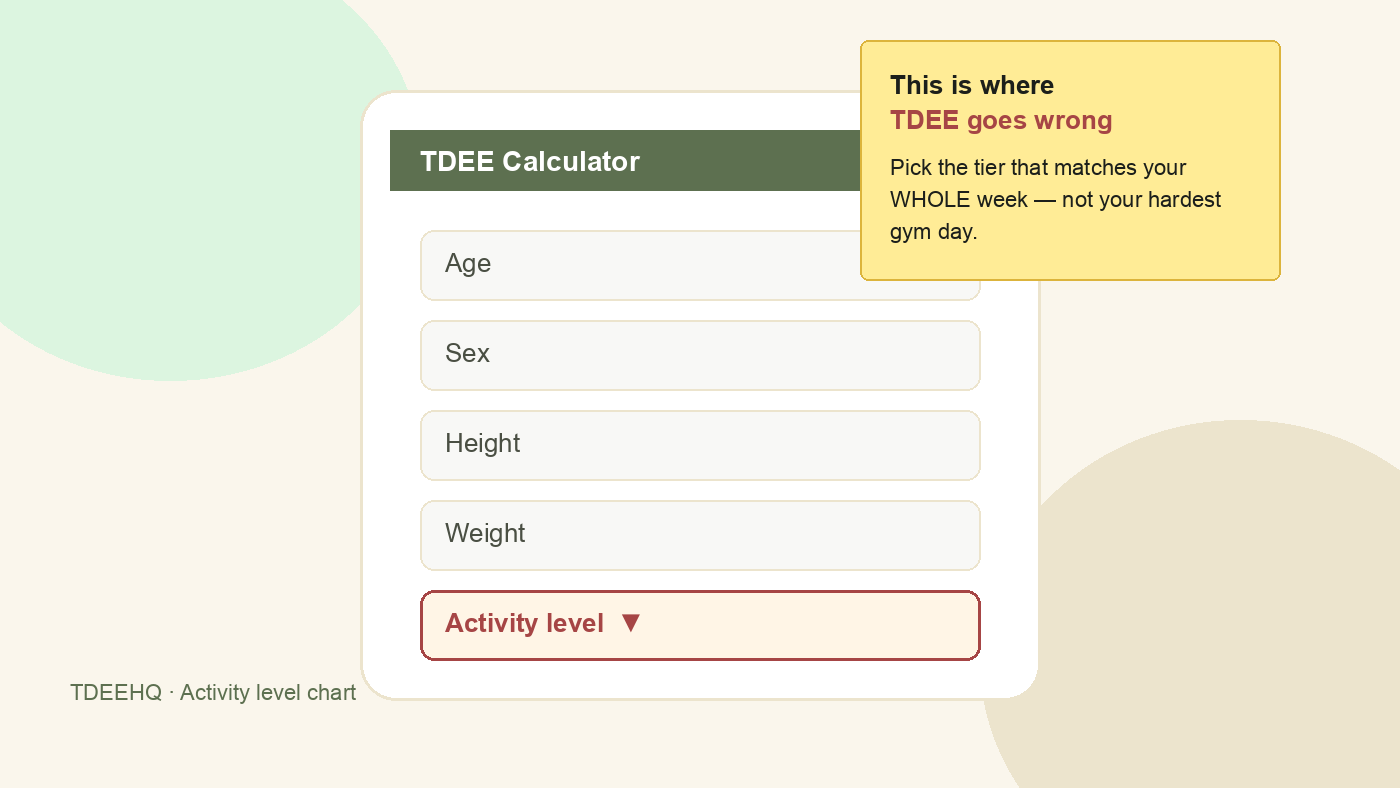
BMR itself usually comes from Mifflin-St Jeor (or Katch-McArdle when body fat is entered). The activity row is where people inflate the whole week — use the TDEE activity level chart before you trust the product.
Maintenance calories are not a separate lab test in this workflow. They are the intake that matches that estimated expenditure closely enough that weekly weight averages stay flat. If your average weight drifts down while intake matches the sticky note, your true maintenance is probably lower than the estimate. If weight drifts up, the estimate was low or logging was leaky — see eating below maintenance not losing weight before you slash again.
When people say “TDEE” but mean something else
This is where is tdee maintenance calories gets a careful “usually.”
1. BMR-only screens Some apps show resting burn and label it loosely. Resting burn is not full-day maintenance. If the number looks like “1,400 kcal” for an adult who walks and trains, you may be staring at BMR, not TDEE.
2. Method 2 baselines If you use a sedentary (or low) TDEE and then add exercise separately, that baseline alone is not your full maintenance until the add is included. Stacking a full activity multiplier and full watch calories is double counting — covered in does TDEE include exercise?.
3. Fitness-watch “active calories” Watch burns are not a TDEE and not a maintenance prescription. They over-read training for many people and ignore whether your calculator activity row already included those sessions.
4. Lab or research TDEE Doubly labeled water or chamber studies measure expenditure differently than a web form. Your free calculator is still an estimate with typical error often cited around ±10% for many adults. Treat it as a starting line, not a verdict.
So: is tdee maintenance calories? On TDEEHQ-style math, yes for planning. When another tool uses a different definition, compare methods, not brand names.
How to use the number — hold, cut, or gain
Once you accept that calculator TDEE is estimated maintenance:
| Goal | Practical rule |
|---|---|
| Hold | Eat near the verified TDEE line (maintenance calculator page) |
| Lose fat | Modest deficit from that line — often ~300–500 kcal/day for many adults (weight-loss TDEE); see goals |
| Gain | Small surplus above the same line; raise slowly if weight jumps too fast |
“Should I eat my TDEE to lose weight?” — No. Eating at TDEE is the hold setting. A cut needs a deficit from a line you trust. If the scale will not move on a paper deficit, fix activity honesty and logging before another slash — again, the stalled deficit guide.
Worked example (lb and kg)
Example adult: woman, 35 years, 5′4″ (163 cm), 150 lb (68 kg), desk job with 2 short workouts — lightly active is a reasonable starting tier.
- 1Estimate BMR with Mifflin-St Jeor (female): roughly 1,350–1,400 kcal/day for these inputs (exact digit depends on the form).
- 2Multiply by lightly active (~1.375) → estimated TDEE / maintenance ≈ 1,850–1,950 kcal/day.
- 3Hold: eat near that band and watch weekly averages.
- 4Cut: try about −400 kcal → ~1,450–1,550 kcal/day as a starting experiment — not a forever sentence.
- 5After ~14 days of consistent logging, compare week-1 vs week-2 average weight. Adjust 100–200 kcal or drop one activity tier — not both at once.
Swap in your own height and weight (lb/kg, in/cm) in the calculator. The structure stays the same: one maintenance line, then a planned offset.
Next step
- 1Pick an honest activity row (activity level chart).
- 2Decide Method 1 vs Method 2 for exercise (does TDEE include exercise?).
- 3Run the free TDEE calculator and label the result maintenance.
- 4Choose hold, cut, or surplus on purpose — then verify with weekly averages.
That is the whole tdee vs maintenance calories decision: one line, clear goal, no duplicate mystery numbers.
One line for maintenance — then hold, cut, or surplus on purpose.
Calculate my TDEEFrequently asked questions
For free multiplier calculators, yes in practice. TDEE is the expenditure estimate; maintenance is the matching intake for stable weight. Same number on the sticky note.
TDEE cluster

Written by
TDEEHQ Editorial
Nutrition & metabolism writersBSc Exercise Science · Certified Sports Nutrition Coach
TDEE, BMR, NEAT, maintenance calories, and honest activity multipliers
Riley leads TDEEHQ’s guides on total daily energy expenditure — translating Mifflin-St Jeor, activity multipliers, and NEAT research into decision tools people can actually use. Focus: picking the right activity level, avoiding double-counted exercise calories, and verifying estimates with weekly weight averages.
Expertise
- TDEE & maintenance calories
- Activity level multipliers
- BMR formulas (Mifflin-St Jeor, Katch-McArdle)
- NEAT & everyday movement
- Deficit sizing from TDEE
- Exercise calorie double-counting