
Key takeaways
- 1Maintenance calories definition: average daily intake that holds weight when lifestyle is steady.
- 2On free BMR × activity tools, estimated TDEE ≈ estimated maintenance for planning.
- 3BMR is resting burn only — usually lower than the number you eat for.
- 4Use maintenance to hold, take a diet break, or set a base for a cut or surplus.
- 5Estimate with a TDEE calculator, then verify with about 14 days of weekly averages.
Maintenance calories meaning, in one line: the average daily calories that keep your weight stable when your lifestyle is stable.
If you have wondered what does maintenance calories mean on a diet app or calculator, that is the answer. It is not a “magic burn” from your watch. It is the hold-weight line — the intake that matches how much energy you use over a normal week.
Direct answer: what does maintenance calories mean?
What does maintenance calories mean? It means the calorie intake that keeps your body weight roughly flat over time — not one lucky morning on the scale, but the trend across days and weeks.
If you eat clearly below that line, you are in a deficit (weight tends to fall if the deficit is real). If you eat clearly above it, you are in a surplus (weight tends to rise). The line itself is maintenance.
On sites like TDEEHQ, that line usually starts as estimated TDEE from Mifflin-St Jeor × activity. Details of the equations live on Methodology.
Estimate TDEE in about 20 seconds — that is your maintenance starting point.
Estimate my maintenance caloriesMaintenance calories definition (plain English)
A clean maintenance calories definition:
> The average number of calories you need each day to maintain your current weight under your usual activity, sleep, and routine.
Three words matter:
- 1Average — weekends and weekdays both count.
- 2Current weight — the number changes when you lose or gain a meaningful amount of weight.
- 3Usual activity — desk weeks and training weeks are not the same story (activity level chart).
Maintenance is a moving target, not a tattoo. After about a 5% body-weight change, or a clear job/training change, recalculate.
What maintenance is for
People treat maintenance as boring. It is not. It is the reference point everything else is measured against.
- Hold weight while you practice tracking, protein, and training consistency — maintenance TDEE page.
- Diet break — return toward maintenance for 1–2 weeks in a long cut so adherence and recovery catch up.
- Reverse / rebuild base — after a hard diet, climbing back toward true maintenance before the next goal.
- Base for a cut or surplus — deficits and surpluses only make sense relative to a line you trust (goals).
Without a trusted maintenance line, a “500 kcal cut” is just a guess relative to a fantasy.
Maintenance vs TDEE vs BMR (short)
Searchers often mix three labels. Keep them separate:
| Term | What it is | How you use it |
|---|---|---|
| BMR | Estimated resting burn (organs, brain, basic living) | Context — not your full-day eating target |
| TDEE | Estimated total daily energy expenditure (BMR × activity, plus lifestyle) | Planning starting point on free calculators |
| Maintenance calories | Intake that holds weight in real life | Goal label — verify with the scale |
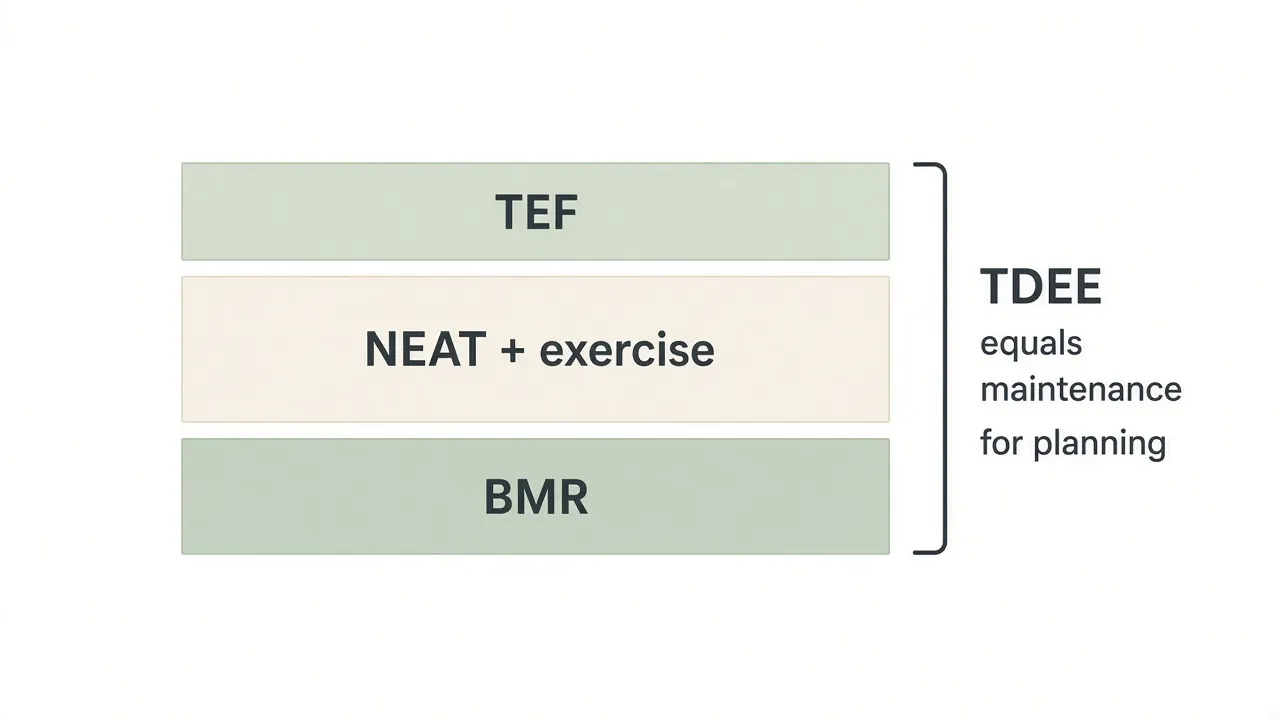
Maintenance vs TDEE
For day-to-day planning on multiplier calculators: TDEE ≈ estimated maintenance. Deep dive: TDEE vs maintenance calories.
Labels can still diverge when someone quotes lab TDEE, BMR-only apps, or a watch that invents a second “active calorie” pile. The fix is the same: one honest estimate, then a short verification loop.
Maintenance vs BMR
BMR is only the resting piece. Eating at BMR for weeks is usually a large cut for most adults — not “maintenance.” Full-day needs include NEAT (daily movement), exercise, and digestion. Formula notes: /#formula.
If your app shows a tiny number that looks like BMR alone, do not call that maintenance. Run full TDEE on the calculator.
How to estimate yours (without a lab)
You do not need a metabolic chamber for a usable planning number.
- 1Enter sex, age, height, and weight in the free TDEE calculator.
- 2Pick an activity tier that matches the whole week — not your hardest gym day.
- 3Write down estimated TDEE as estimated maintenance.
- 4Optional: check the raw math on the Mifflin-St Jeor calculator.
- 5Verify about 14 days with weekly weight averages before hard cuts.
Step-by-step methods: how to figure out your maintenance calories.
Ballpark rows (not your prescription)
Want sample rows by body weight first? See maintenance calories by weight (e.g. 150 lb / 68 kg examples) — then recalculate with your height, age, and activity. Weight alone is never enough.
Do not double-count exercise
If your activity tier already includes training and walking, do not also add a full watch burn on top. That stacks the same work twice. Guide: does TDEE include exercise?.
Can you lose fat or build muscle at maintenance?
Short answers for the questions people type next:
Can you lose fat at maintenance?
Usually not much on purpose. Fat loss needs a sustained energy deficit. “Recomp” (lose some fat while holding weight) can happen for beginners or returners, but most adults who want clear fat loss should use a modest deficit from a verified line — weight-loss TDEE — not pretend maintenance is a cut.
Can you build muscle at maintenance?
Sometimes, especially if you are new to lifting, returning after time off, or improving protein and sleep. Progress is often slower than in a small surplus. Advanced lifters usually need a surplus for meaningful muscle gain. Either way, lock maintenance first so you know whether you are truly holding, cutting, or growing.
Is “eating at maintenance” the same as “eating at TDEE”?
On this site’s style of calculator: yes for planning — until the scale disagrees. If weekly averages rise while you “eat at TDEE,” your true maintenance is lower (or logging is incomplete). If they fall, you were already in a deficit.
Common meaning mistakes
- Calling BMR “maintenance.” Resting burn ≠ full-day needs.
- Treating one chart for your weight as destiny. Height, age, and activity move the result.
- Ego activity tiers. Desk + two lifts is rarely “athlete.”
- Judging one morning weigh-in. Water noise is normal — use weekly averages.
- Cutting from an unverified line. Deficit relative to a fantasy fails.
- Assuming the watch is the definition. Wearables estimate; they do not redefine maintenance.
- Copying a partner’s number. Sex, height, and lean mass differ — run your own inputs.
If paper says you are below maintenance and nothing moves, audit logging first: eating below maintenance not losing weight.
How this page fits the cluster
| You want… | Go here |
|---|---|
| Plain definition | This page |
| Are TDEE and maintenance the same label? | TDEE vs maintenance |
| Step-by-step how to find the number | How to figure out maintenance |
| Sample rows by weight | Maintenance by weight |
| Hold-weight calculator framing | Maintenance tool |
Next step
- 1Run the free TDEE calculator with honest activity.
- 2Treat the result as estimated maintenance — not a lab report.
- 3Optional: inspect the equation on Mifflin-St Jeor or Methodology.
- 4Verify ~14 days, then choose hold, cut, or surplus on goals.
Estimate TDEE in about 20 seconds — that is your maintenance starting point.
Calculate my maintenance caloriesFrequently asked questions
The average daily calories that keep your weight stable when your lifestyle is stable. On free calculators, start with estimated TDEE, then confirm with the scale.
TDEE cluster

Written by
TDEEHQ Editorial
Nutrition & metabolism writersBSc Exercise Science · Certified Sports Nutrition Coach
TDEE, BMR, NEAT, maintenance calories, and honest activity multipliers
Riley leads TDEEHQ’s guides on total daily energy expenditure — translating Mifflin-St Jeor, activity multipliers, and NEAT research into decision tools people can actually use. Focus: picking the right activity level, avoiding double-counted exercise calories, and verifying estimates with weekly weight averages.
Expertise
- TDEE & maintenance calories
- Activity level multipliers
- BMR formulas (Mifflin-St Jeor, Katch-McArdle)
- NEAT & everyday movement
- Deficit sizing from TDEE
- Exercise calorie double-counting