Key takeaways
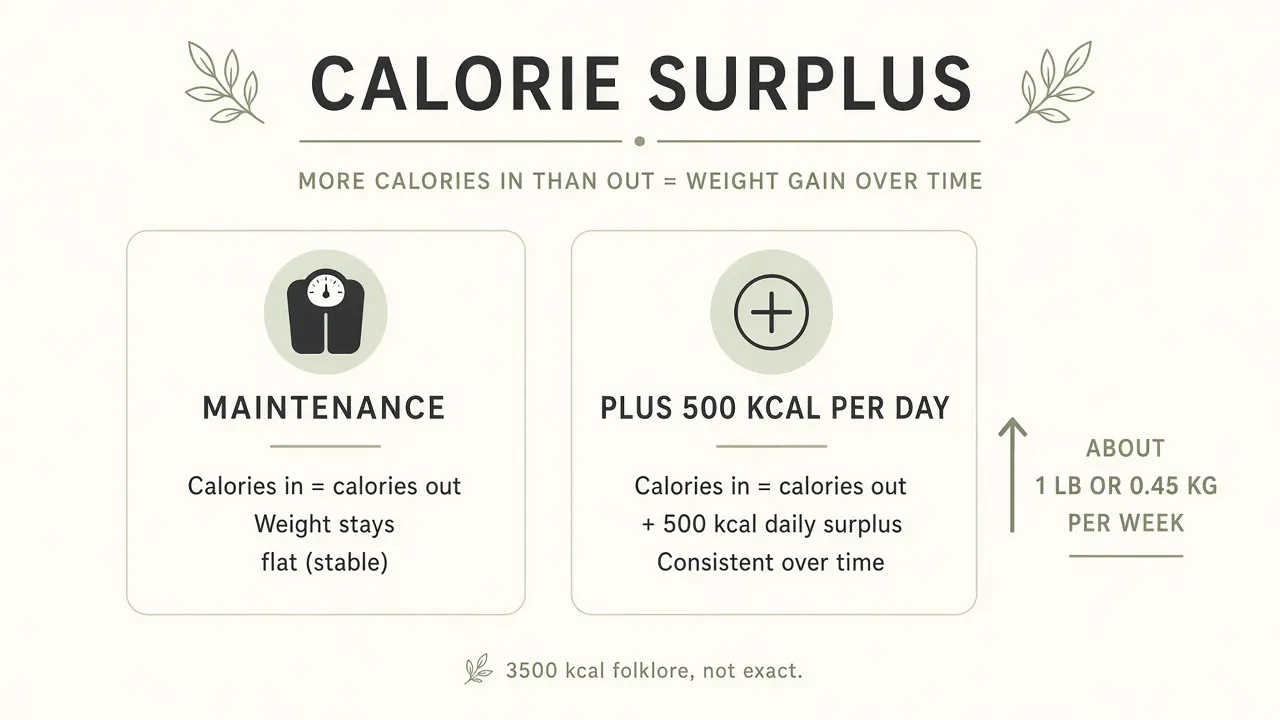
- 1About 3,500 calories over maintenance ≈ 1 pound (0.45 kg) of body weight (rough guide).
- 2A 500-calorie daily surplus ≈ 1 lb (0.45 kg) per week.
- 3For muscle with less fat, a smaller surplus of 250–300 kcal often works better.
- 4Your maintenance number is an estimate — test it with 2–3 weeks of weekly averages.
- 5Eat enough protein and train — or the extra weight will be mostly fat.
- 6Contrast: a weight-loss page sizes a deficit; this page sizes a surplus from the same TDEE.
How many calories over maintenance to gain a pound? About 3,500 extra calories over time — roughly a 500-calorie surplus per day for about 1 pound (0.45 kg) per week.
This is a good rule of thumb, not a perfect law. Your body, muscle gain, and water weight all change the result. Start from a verified maintenance / TDEE line first — then size the surplus.
Estimate TDEE first — then add a modest surplus and track weekly averages.
Calculate my TDEEWhat does “over maintenance” mean?
Maintenance calories are the calories you eat to keep your weight the same. Eat above that number and you gain weight. Eat below it and you lose weight.
Maintenance is also called TDEE (total daily energy expenditure). Full plain-English definition: maintenance calories meaning. Deep label compare: TDEE vs maintenance calories.
Not sure of your number? Use our free TDEE calculator for a starting estimate in under a minute. For how BMR becomes full-day maintenance, see /#formula and maintenance calories meaning.
Calories over maintenance to gain a pound: the numbers
One pound of body weight is estimated at about 3,500 calories of stored energy. In metric units, 1 kilogram is about 7,700 calories.
To gain weight, you must eat that extra amount over time:
- 3,500 extra calories in a week = 500 extra calories per day ≈ 1 lb (0.45 kg) per week
- 7,000 extra calories in a week = 1,000 extra calories per day ≈ 2 lb (0.9 kg) per week
- 7,700 extra calories ≈ 1 kg of weight
These numbers describe total body weight. That includes muscle, fat, water, and food in your gut — not pure muscle.
Daily surplus chart (lb and kg)
| Daily surplus | Weekly surplus | Expected gain per week | Expected gain in kg |
|---|---|---|---|
| +250 kcal | 1,750 kcal | About 0.5 lb | About 0.23 kg |
| +500 kcal | 3,500 kcal | About 1 lb | About 0.45 kg |
| +750 kcal | 5,250 kcal | About 1.5 lb | About 0.68 kg |
| +1,000 kcal | 7,000 kcal | About 2 lb | About 0.9 kg |
Most people should stay near the top two rows. Bigger surpluses usually add more body fat than muscle. Goal framing on the site: /#goals.
Why the 3,500 rule is not exact
The 3,500 rule is a useful guide, but real bodies are not simple calculators.
- Your metabolism rises a little as you eat more and as your body gets heavier.
- Muscle, fat, and water store different amounts of energy.
- Water weight can swing 1–3 pounds (0.5–1.4 kg) in a day from salt, carbs, and stress.
- Your maintenance number is only an estimate — confirm with weekly averages (see how to figure out maintenance calories).
Judge progress by a weekly average, not by one morning weigh-in.
How to find your maintenance calories
You need a starting point before you can add a surplus. Three simple ways:
- 1Use a calculator. Our TDEE calculator uses age, sex, height, weight, and activity.
- 2Do it by hand. Read how to figure out your maintenance calories step by step.
- 3Track food and weight for 2–3 weeks. If weekly average weight stays flat, the calories you ate are close to maintenance.
Two parts decide the result: the formula and the activity level. Compare Mifflin-St Jeor and Katch-McArdle, and check the activity level chart. When unsure, choose the lower activity level. Do not double-count watch burns on top of the multiplier — does TDEE include exercise?.
What is the best surplus to build muscle?
Most people do best with a small surplus of 250–500 calories per day.
| Experience level | Suggested surplus | Why |
|---|---|---|
| Beginner (under 1 year lifting) | +300 to +500 kcal | Muscle grows faster; extra fuel is used well |
| Intermediate (1–3 years) | +200 to +300 kcal | Muscle gain slows |
| Advanced (3+ years) | +100 to +250 kcal | Large surpluses become mostly fat |
A simple target for beginners is about 1–2 pounds (0.45–0.9 kg) of muscle per month. Experienced lifters gain much less. Tool framing: muscle-gain TDEE or bulking.
Example: gaining 1 pound per week
Say your maintenance is 2,200 kcal/day (a 165 lb / 75 kg person with a moderate activity level).
- Add 500 calories → eat about 2,700 kcal/day.
- Over 7 days ≈ 3,500 extra calories.
- Expected change ≈ 1 lb (0.45 kg) per week.
Weigh once a week at the same time of day. If weight does not change after two weeks, add another 100–200 kcal. If you gain faster than ~1 lb/week and waist grows quickly, lower the surplus.
How to gain a pound a week: 7 steps
- 1Find your maintenance calories with the TDEE calculator and write the number down.
- 2Add your surplus — start with +300 to +500 kcal/day.
- 3Eat enough protein: 0.7–1 g per lb (1.6–2.2 g per kg). A 165 lb (75 kg) person needs about 115–165 g/day. Macro split help: TDEE macro calculator.
- 4Train with progressive resistance a few times per week (keep it simple — this is not a workout program).
- 5Sleep enough for recovery.
- 6Weigh weekly — same scale, time, and clothing.
- 7Adjust every 2 weeks by only 100–200 kcal if the trend is off.
If paper says you are in a surplus but nothing moves, audit logging first (same honesty checks as eating below maintenance not losing, flipped for gain).
Easy ways to add ~500 calories
Some people feel full fast. Calorie-dense foods help without giant meals.
| Food | Portion | Approx. calories |
|---|---|---|
| Peanut butter | 2 tablespoons (32 g) | 190 |
| Whole milk | 1 cup (240 ml) | 150 |
| Olive oil | 1 tablespoon (15 ml) | 120 |
| Mixed nuts | 1 ounce (28 g) | 170 |
| Cooked rice | 1 cup (about 160 g) | 205 |
| Banana | 1 medium | 105 |
| Rolled oats (dry) | 1/2 cup (40 g) | 150 |
Example: milk + peanut butter sandwich + a handful of nuts ≈ 500 kcal.
A simple +500 day
Start with your normal meals, then add:
- Breakfast: whole milk + banana (~255 kcal)
- Snack: handful of nuts (~170 kcal)
- Dinner: 1 tablespoon olive oil (~120 kcal)
That is about 545 extra calories without a huge meal.
Lean gain vs fat gain
When you eat above maintenance, the extra weight is not all muscle. Some fat is normal.
You can improve the ratio:
- Keep the surplus small
- Progress training over time
- Hit protein
- Avoid gaining more than about 0.5–1% of body weight per month once experienced
If your belt gets tight much faster than strength improves, the surplus is probably too big — see muscle-gain for a smaller surplus framing, or weight-loss if you need to reverse course.
Common mistakes
- Guessing maintenance — estimate, then verify with real weight data
- Not tracking food — many people under-eat relative to what they think
- Changing calories too often — wait two weeks
- Skipping training — without progressive work, extra calories become fat
- Judging by one day — daily weight swings are mostly water
Final thoughts
The short answer to how many calories over maintenance to gain a pound is about 3,500, or roughly 500 per day for 1 lb (0.45 kg) per week. Start with your maintenance number, add a modest surplus, train, and track your weekly average.
Estimate TDEE first — then add a modest surplus and track weekly averages.
Get my TDEE, then set a surplusRelated reading
Frequently asked questions
About 3,500 calories over time, or roughly 500 extra calories daily for 1 pound (0.45 kg) per week — as a rule of thumb, not a lab law.
TDEE cluster

Written by
TDEEHQ Editorial
Nutrition & metabolism writersBSc Exercise Science · Certified Sports Nutrition Coach
TDEE, BMR, NEAT, maintenance calories, and honest activity multipliers
Riley leads TDEEHQ’s guides on total daily energy expenditure — translating Mifflin-St Jeor, activity multipliers, and NEAT research into decision tools people can actually use. Focus: picking the right activity level, avoiding double-counted exercise calories, and verifying estimates with weekly weight averages.
Expertise
- TDEE & maintenance calories
- Activity level multipliers
- BMR formulas (Mifflin-St Jeor, Katch-McArdle)
- NEAT & everyday movement
- Deficit sizing from TDEE
- Exercise calorie double-counting